
 EN
EN
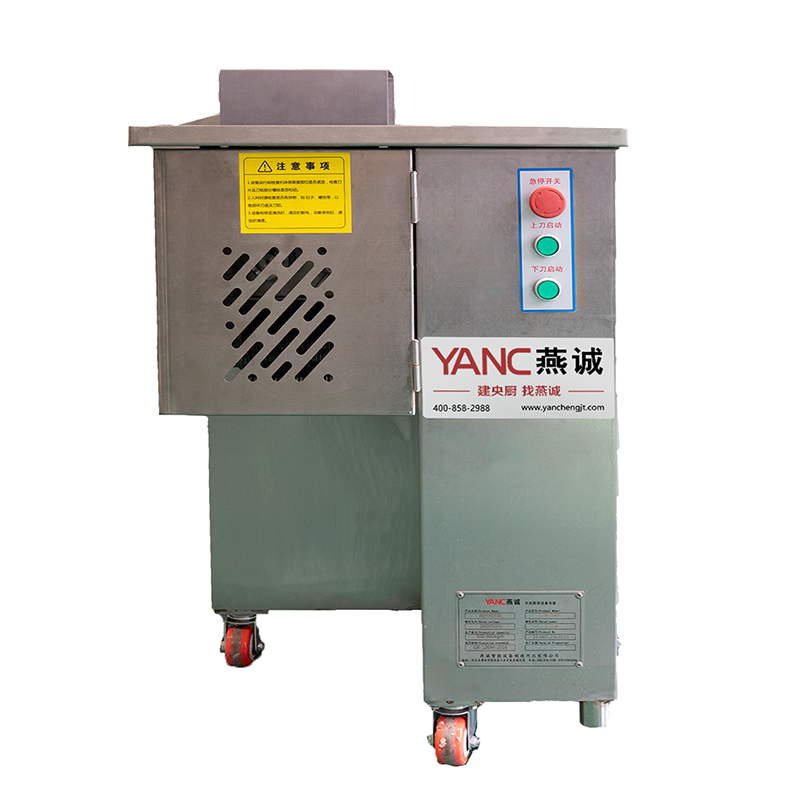
How the Dual Blade Meat Slicer Works: Engineering and Design Advantages
What Is a Dual-Blade Meat Slicer and How It Operates
Dual blade meat slicers work with two spinning blades going in opposite directions which makes them much better at slicing stuff quickly. These aren't like old fashioned single blade machines where everything gets stuck sometimes. The way these work is pretty clever actually - one blade starts making contact first, then the second one comes in right after to finish off the slice and keep things smooth without so much resistance. Most models come with motor driven conveyors that move whatever needs slicing along at different speeds depending on what kind of product we're talking about here. Deli meats, cheese blocks, those cured meats people love? No problem for these machines. What really stands out though is how they stop those annoying half slices that happen all the time with regular slicers. Restaurants using these report saving around 15 to maybe even 20 percent worth of product each week just from not having wasted bits lying around anymore.
Core Engineering Principles Behind Synchronized Dual-Head Systems
The blades stay properly aligned thanks to timing systems that work with servos capable of spinning them as fast as 1500 revolutions per minute. Special sensors keep track of tension so they can adjust themselves whenever the blades start to dull from regular use. Each blade gets its own gear drive system, something really important when dealing with tough stuff like cured meats that put extra strain on everything. The whole cutting area sits on mounts designed to absorb vibrations, allowing slices to come out consistently accurate within about a tenth of a millimeter even when running at maximum speed through heavy loads.
Single vs. Dual-Blade Meat Slicers: Key Differences in Design and Performance
| Feature | Single-Blade Slicers | Dual-Blade Systems |
|---|---|---|
| Cycle Speed | 200–400 slices/hour | 550–800 slices/hour |
| Waste Rate | 8–12% | 3–5% |
| Energy Use | 1.2–1.8 kWh | 1.5–2.1 kWh |
| Maintenance Frequency | Every 40 operating hours | Every 60–80 operating hours |
Dual-blade systems deliver 40% faster throughput while maintaining tighter tolerances, offering a clear advantage for commercial kitchens requiring uniform portioning.
Precision Slicing and Uniformity: Maximizing Consistency in Commercial Cuts
Achieving exact portion control and slice uniformity with dual blade systems
Counter-rotating blades enable ±0.2 mm thickness consistency by cutting simultaneously from opposing directions, eliminating the "drag effect" that causes uneven slices in single-blade units due to partial deflection. According to 2023 foodservice equipment surveys, commercial kitchens report 23% fewer customer complaints about portion discrepancies after switching to dual-blade systems.
Blade synchronization and its role in reducing product waste
With servo motors keeping blades in sync every 0.01 seconds, these systems stop those annoying off-center cuts that can waste anywhere from 8 to 12 percent of expensive ingredients during single blade operation. For anyone working with fine meats or making those ultra thin carpaccio slices, this kind of accuracy makes all the difference. What's really impressive though is how the machine adapts its cutting angle depending on what it's handling. Soft stuff like mortadella gets treated differently than something firmer or even semi frozen prosciutto. The result? Clean cuts across the board without damaging the product integrity, which saves money and maintains quality standards in food processing facilities.
Case study: 98% slicing consistency in high-volume operations
During a year long look at operations at one of the country's largest meat processing plants, they discovered something interesting about slicing equipment. The dual blade systems kept things consistent for around 98 out of every 100 slices made over 14 million pieces total. Single blade machines only hit about 89% accuracy in comparison. When working with frozen meats, which get harder or softer depending on how cold they are, those single blades would actually tilt as much as 1.7 degrees from straight. But when using the dual blade setup, this problem disappears completely because the second blade balances out any wobble in real time.
Is a dual-blade system overkill for small-scale operations?
Operations that deal with under 50 pounds of product each day might find the 40% price tag hard to justify. But for those caterers who focus on high-end charcuterie boards, most see their money back in around 18 months or so because they waste less stuff and their presentations look better overall, even when they're not moving massive amounts. When thinking about whether this makes sense, it really comes down to what the products are worth, how consistent everything needs to be, and what kind of improvements the business wants to see in their staff productivity.
Increased Efficiency and Throughput in High-Volume Kitchen Environments
How Dual Blade Meat Slicers Boost Production Speed and Kitchen Efficiency
Dual-blade slicers eliminate downtime between cycles through alternating operation: as one blade retracts, the second engages immediately, enabling continuous flow on conveyor-fed systems. This synchronized process allows kitchens to process 120–150 portions per minute without manual repositioning of meats or cheeses.
Quantified Gains: 40% Faster Throughput Versus Single-Blade Models
Independent testing confirms dual-blade configurations reduce idle time by 53%, resulting in 40% higher hourly output (Food Production Journal 2023). In delis processing 800 lbs of product daily, this improvement saves 2.1 labor hours per shift—equivalent to $19,500 annually at average culinary wages.
Future Trends: Automation and Smart Integration in Next-Gen Dual-Blade Slicers
Emerging models feature IoT-enabled load sensors that automatically adjust blade speed based on food density, sync with inventory management systems, and predict maintenance needs via vibration analysis. Prototype systems now achieve 99% portion weight consistency using AI-driven adaptive slicing algorithms, minimizing both waste and manual quality checks.
Versatility in Handling Different Meats and Cheeses
Adapting the Meat Slicer for Various Food Types: From Deli Meats to Hard Cheeses
Dual blade slicers today can tackle pretty much anything thrown at them, from those super thin 0.2 to 0.5 mm slices of prosciutto right up to 3 to 5 mm thick cuts of hard cheese. The manufacturers really put thought into what kind of blades work best for different jobs. For cutting meat they go with hardened stainless steel that stays sharp at around 60 to 62 on the hardness scale. But when it comes to older cheeses that tend to crumble, they add these tiny serrations along the edge. What this means is chefs can switch back and forth between things like smoked turkey which needs an internal temperature of about 42 degrees Fahrenheit and aged gouda that works better at around 55 degrees F without ever having to stop and change blades mid-prep.
Blade Calibration Techniques for Soft Versus Hard Food Products
Optimal performance depends on proper calibration of RPM and tension settings:
- Soft items (mortadella, brie): 250–300 RPM with 15–20 psi tension prevents tearing
- Firm products (salami, parmesan): 400–450 RPM and 30–35 psi tension minimizes deflection
A 2023 Food Processing Technology study showed that calibrated operation reduces product defects by 18% compared to fixed-setting slicers. Temperature-stabilized blade housings (±2°F) further preserve material consistency during extended runs.
Dynamic Tension Adjustment: Strategy for Optimal Slicing Across Variable Loads
Advanced models use real-time load sensors to automatically regulate blade torque, adapting to:
- Irregular shapes (e.g., tapered prosciutto legs)
- Density variations in artisan cheeses (18–35 lb/ft³)
- Texture shifts caused by temperature during continuous use
This dynamic control sustains ±0.1 mm uniformity when switching between 2 lb poultry breasts and 8 lb cheese wheels. Kitchens using adaptive tension report 24% less waste than those relying on static systems, according to the 2023 FoodTech Engineering Report.
FAQ Section
What are the main advantages of using dual blade meat slicers?
Dual blade meat slicers offer faster slicing speeds, reduced product waste, improved portion consistency, and better handling of various food types compared to single blade slicers.
Can dual blade slicers be used in small-scale operations?
Although dual blade slicers are primarily designed for high-volume operations, small-scale caterers focusing on quality may find the initial investment worthwhile due to long-term savings and improved presentation.
How do dual blade systems reduce product waste?
Dual blade systems minimize waste through synchronized slicing, preventing off-center cuts and controlling slicing angles for precise cuts in various food textures.